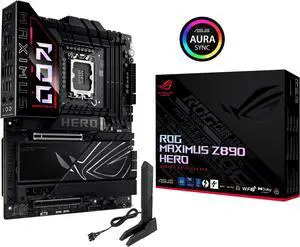
Overview
The ASUS ROG Maximus Z890 Hero is a flagship ATX motherboard built on the Z890 chipset for Intel Core Ultra (Arrow Lake) processors. With 24+1 power stages, 6x M.2 slots, and DDR5 support up to 256GB, it targets enthusiasts and power users who demand premium features and rock-solid reliability.
Full Specifications
| Socket | LGA 1851 |
| Chipset | Z890 |
| Form Factor | ATX |
| Memory | DDR5, 4 DIMM slots, up to 256GB |
| PCIe Slots | 1x PCIe 5.0 x16, 1x PCIe 4.0 x16 (x4 mode), 1x PCIe 4.0 x1 |
| M.2 Slots | 6x M.2 |
| SATA Ports | 4 |
| Rear USB | 11x USB (incl. Thunderbolt 4) |
| WiFi | WiFi 7 |
| Bluetooth | BT 5.4 |
| LAN | 5G+2.5G |
| Audio | ALC4082 |
| Power Phases | 24+1 |
Slot Sharing & Conflicts
Every M.2 and PCIe slot draws its lanes from either the CPU or the chipset, and on this board some of them share. Filling one slot can slow another, and the board gives you no warning when it happens. Here is what each slot costs, taken from ASUS's published specifications.
| Slot | Connected to | Link | What it costs you |
|---|---|---|---|
| M.2_1 | CPU | PCIe 5.0 x4 | Nothing. Fill this one first. |
| M.2_2 | CPU | PCIe 4.0 x4 | Nothing. |
| M.2_3 | CPU | PCIe 5.0 x4 | Graphics slot drops to x8. |
| M.2_4 | CPU | PCIe 5.0 x4 | Graphics slot drops to x8. |
| M.2_5 | Chipset | PCIe 4.0 x4 | Nothing. |
| M.2_6 | Chipset | PCIe 4.0 x4 | Nothing. |
ASUS states it plainly: "When M.2_3 or M.2_4 is enabled, PCIEX16(G5) will run x8 only." Note the word or — one drive is enough, you do not need both. In practice a graphics card loses very little at PCIe 5.0 x8, but if you want the full x16 link, put your second and third drives in M.2_5 and M.2_6 instead. Our PCIe guide explains why half the lanes on a modern generation still carries plenty of bandwidth.
Source: ASUS ROG Maximus Z890 Hero specifications, checked 2026-09-01.
Design & Build Quality
ASUS has pulled out all the stops on the ASUS ROG Maximus Z890 Hero. The board features an extensive heatsink array covering the VRM, chipset, and M.2 slots, with a premium aesthetic that includes brushed metal accents and subtle RGB integration. The PCB is a high-quality multi-layer design built for signal integrity at high frequencies, and the overall build quality is immediately apparent when you handle the board.
VRM & Power Delivery
The 24+1 power stage design is seriously impressive. This VRM can handle sustained heavy overclocking on even the most demanding processors without breaking a sweat.
Connectivity & I/O
WiFi 7 brings tri-band support, 320 MHz channels, and Multi-Link Operation (MLO) for blazing wireless speeds and reduced latency — ideal for competitive gaming and large file transfers. 5 Gigabit Ethernet provides excellent wired speeds for NAS and local network transfers. The rear panel features 11x USB (incl. Thunderbolt 4), providing ample connectivity for peripherals, external storage, and high-speed devices.
Pros & Cons
Pros
- Excellent VRM with 24+1 power stages for overclocking headroom
- Generous 6x M.2 slots for extensive NVMe storage
- Latest WiFi 7 for future-proof wireless connectivity
- Thunderbolt 4 support for ultra-fast data transfer and peripherals
- 5 Gigabit Ethernet for high-speed wired networking
Cons
- Premium pricing that may be hard to justify for non-enthusiasts
Who Should Buy This Board?
Enthusiasts and power users who want the absolute best Intel Core Ultra (Arrow Lake) platform experience. Content creators running heavy workloads, competitive overclockers, and builders who refuse to compromise on features or build quality.
Build Tips & Recommendations
- LGA 1851 shares the same mounting pattern as LGA 1700, so existing LGA 1700 coolers will work without modification.
- Enable XMP 3.0 in BIOS to run your DDR5 kit at rated speeds. DDR5-6000 to DDR5-6400 offers the best performance-per-dollar for most users.
- With 6x M.2 slots available, install your OS in M.2_1 for maximum speed. Before you fill the rest, check the Slot Sharing table above — M.2_3 and M.2_4 borrow lanes from the graphics slot, so M.2_5 and M.2_6 are the better second and third choices.
- Any standard ATX mid-tower or full-tower case will work. Ensure your case has sufficient fan mounting points and front panel USB headers that match this board's internal connectors.
- Always update to the latest BIOS before installing components for the best compatibility, especially with newer CPUs and RAM kits. Download the BIOS file to a USB drive and use the flashback feature if available.
Video Review
Related Boards
Already own this board? The LGA 1851 upgrade path covers which processors this socket still takes, when a firmware update has to come first, and how much upgrade life the platform has left.
Weighing two boards? Compare this board side by side with the first one below, then swap in anything else from the dropdowns.